

TL;DR
- Federal court rulings temporarily halted HRSA’s voluntary rebate pilot program while simultaneously overturning stringent child-site registration rules to restore critical operational flexibility for off-site specialty clinics.
- Pharmaceutical manufacturers are aggressively squeezing hospital margins by conditioning standard upfront discounts on the submission of highly granular, claim-level data for in-house pharmacy operations within a strict 45-day window.
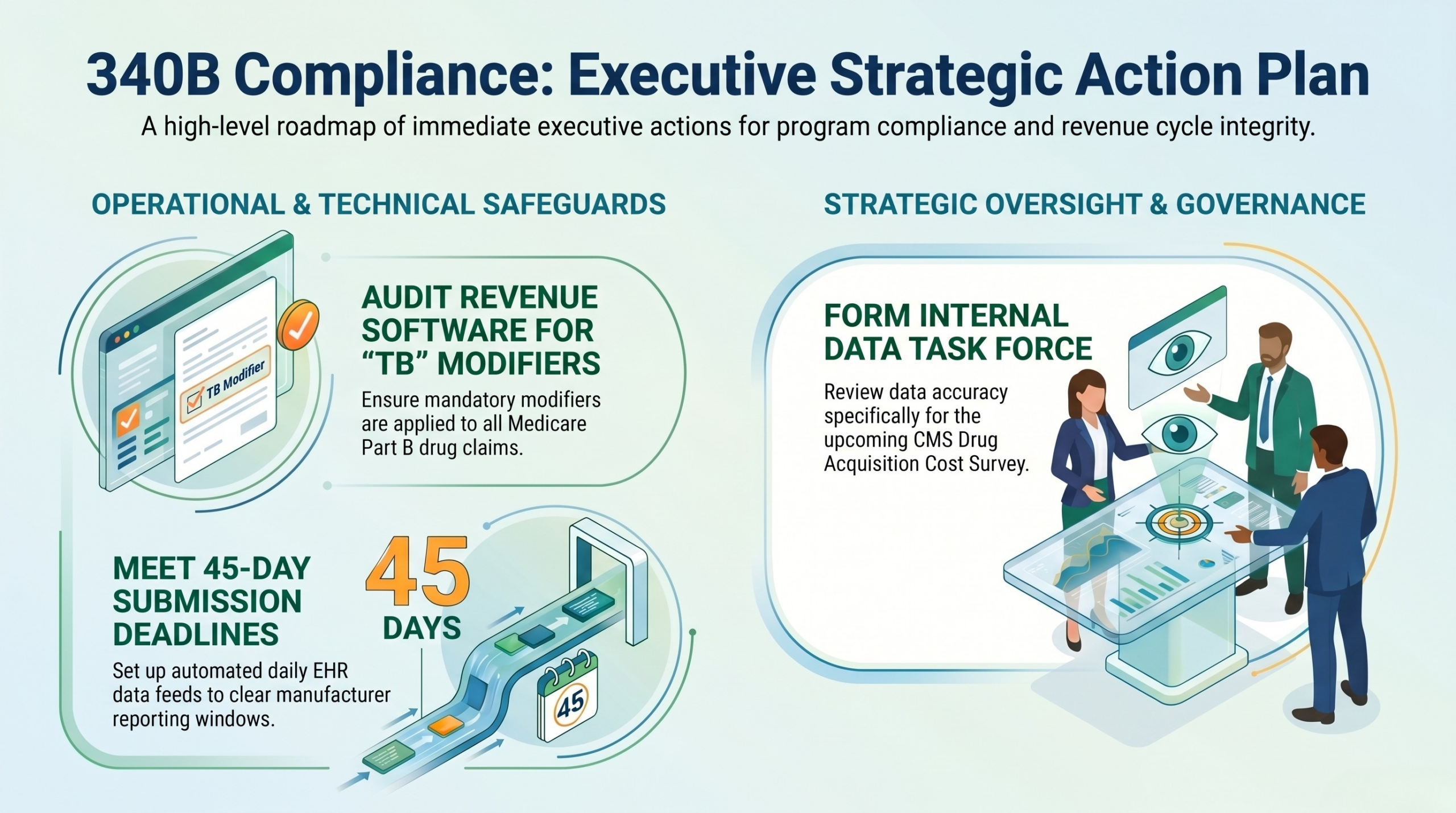
- Revenue cycle must hardcode mandatory "TB" billing modifiers for Medicare Part B claims with precise data for the upcoming CMS Drug Acquisition Cost Survey to prevent severe compliance penalties and payment cuts.
- Hospitals need dedicated data reconciliation workflows and automated validation tools to sync EHR data with split-billing software, to avoid duplicate discount risks and provide the data required to challenge unfair pricing denials.
Table of Contents
Managing a hospital pharmacy program requires balancing clinical excellence with fiscal sustainability. The 340B Drug Pricing Program is the foundation of that financial stability for safety-net hospitals across the United States. However, maintaining compliance while optimizing 340b billing has become a moving target.
Recent regulatory pivots, legal battles, and shifting policies from pharmaceutical manufacturers are forcing a rapid evolution in how covered entities manage their claims. Senior leaders in pharmacy, oncology, and patient financial services must understand these shifting undercurrents and adapt their operational workflows immediately to protect pharmacy margins and insulate from compliance risks.
The Volatile 340B Landscape: 2026 in Context
The operational framework of the 340B program is experiencing unprecedented turbulence. The program operated seamlessly as a point-of-sale discount mechanism for decades. Covered entities purchased 340b drugs at or below the statutory ceiling price, dispensing them directly to eligible patients or through contract pharmacy networks.
That predictability dissolved when the Health Resources and Services Administration (HRSA) attempted to introduce its voluntary 340B Rebate Model Pilot Program. The model aimed to shift the entire system toward a post-dispense rebate framework, a change that threatened to disrupt hospital cash flows and add massive administrative burdens.
The legal landscape shifted again on February 10, 2026. The U.S. District Court for the District of Maine vacated and remanded HRSA’s rebate pilot notice. The court ruled that the agency failed to follow the necessary administrative procedures under the Administrative Procedure Act (APA).
This ruling forced a temporary return to traditional upfront discounts but the threat of a structural 340b expansion into rebate models remains active. HRSA closed its Request for Information (RFI) on the matter on April 20, 2026, signaling that federal oversight bodies are still aggressively pursuing alternative pricing verification frameworks.
On top of this rebate friction, hospital systems are adjusting to a major compliance victory. On March 3, 2026, a federal district court overturned HRSA’s stringent child-site registration requirements. Off-site clinics are no longer forced to wait out protracted Medicare cost report cycles before accessing 340B pricing. This return to pandemic-era flexibility eliminates massive operational delays, allowing oncology and specialty clinics to provide cost-effective treatments to vulnerable populations much faster.
The Escalation of Manufacturer Data Demands
While federal rebate pilots face legal delays, pharmaceutical manufacturers are taking matters into their own hands. Drugmakers are aggressively altering day-to-day pharmacy operations by conditioning 340B discounts on the submission of granular, claim-level data.
Historically, manufacturer data restrictions focused primarily on external contract pharmacies. That boundary has vanished. As of early 2026, both Eli Lilly and Novo Nordisk have fully enacted policies requiring covered entities to submit extensive dispensing data for in-house pharmacy operations within 45 days of a dispense. Exelixis and several other manufacturers are rolling out similar demands.
Failure = Loss of 340B
This is a major operational escalation for pharmacy directors. Failure to upload this data cleanly results in an immediate loss of access to 340B pricing. Hospitals across the country are already reporting anecdotal pricing denials on routine orders.
Patient financial services and pharmacy teams must establish rapid reconciliation workflows to mitigate these losses. Your primary recourse is HRSA’s Administrative Dispute Resolution (ADR) process if your facility faces unjustified pricing restriction,. Documenting these losses with bulletproof data is essential to launch an ADR claim and claw back lost savings.
Strategic Imperatives for 340B Billing and Compliance
Navigating these overlapping reforms requires structural changes to your technology and staffing models. Leaders cannot afford a reactive approach to compliance.
1. Hardcode Evolving Modifier Requirements
- Use the “TB” modifier on claims for separately payable Medicare Part B drugs and biologics.
- Ensure your revenue cycle software automatically applies these modifiers based on exact National Drug Code (NDC) numbers to prevent severe billing discrepancies.
2. Formulate a Comprehensive Survey Response Strategy
Federal oversight is expanding into hospital acquisition costs. Under the 2026 Outpatient Prospective Payment System (OPPS) final rule, CMS is collecting NDC-level data for outpatient drugs acquired over the past year.
This drug acquisition cost survey covers both 340B and non-340B medications. Revenue cycle leaders must treat this data aggregation with extreme care. The metrics submitted today will directly shape CMS outpatient drug payment and reimbursement policies heading into 2027.
3. Build a Dedicated Data Reconciliation Team
- Invest in automated data validation tools that cross-reference split-billing software logs against internal Electronic Health Records (EHR).
- Eliminate duplicate discount risks before claims leave your facility.
- Continuously monitor for overlapping price reductions driven by Medicare’s Maximum Fair Price (MFP) initiatives.
Protecting the Future of Safety-Net Care
The 340B program remains an indispensable mechanism for stretching scarce federal resources and expanding comprehensive care. But the administrative burden needed to defend these savings is scaling exponentially.
Your hospital must blend rigid compliance frameworks with agile data management technology to insulate your bottom line from ongoing manufacturer restrictions and shifting federal guidelines.
Evaluate your current third-party administrator (TPA) contracts and internal auditing structures today. Ensuring your billing workflows are resilient against these 2026 regulatory realities is the only way to safeguard your margins and protect the patient populations who rely on your care.